The phrase "Just Do It" has been made famous by Nike. Emphasizing the importance of getting up and doing what is needed, such as running farther, lifting when you're tired, or training for that swim meet, even when you don't feel like it. So why don't we do it? Why do we continue to sit and watch TV or scroll through Instaham (yes, this is what I call it)? This is especially relevant during the New Year's as goals are made and lost.
The Strength of our Intentions
Closing the distance of the Intention Behavior Gap, the failure to translate actions into behavior, is a central tenet of our human situation. I've discussed many times the ability to increase your strength while exercising, especially through resistance training. The amount of time we stick to our New Year's resolutions is termed "intention strength."
Intention strength makes you stick to your goals, and this begs the question: What makes an intention strong? Research on intentions shows five major characteristics of intention strength.
- Intention certainty refers to the degree of confidence an individual has that his or her intention is correct/clear to him or her.
- Moralization or moral conviction is the degree to which the intention reflects a strong and absolute belief that something is right versus wrong, moral versus immoral, or that it reflects core moral values and convictions. This helps reduce decision fatigue.
- Intention importance refers to the degree to which an individual attaches significance to the intention or behavior.
- Intention knowledge refers to the amount of information the individual has about the behavior (i.e., knowledge volume). Greater attitude knowledge is associated with stronger attitude–behavior relationships.
- Relatedly, elaboration is the degree of thought or careful consideration one has given to the merits and shortcomings of a behavior.
A repeating intention that many patients come into my office with is losing weight.
Crafting the intention might look similar to:
"This year, I commit to caring for my body with patience and consistency by nourishing it well, moving it regularly, and trusting that small daily choices will lead to sustainable weight loss and lasting confidence."
This allows forward progress without restrictions that can be interpreted as failure. In other words, I did not state a goal of 5 pounds per month (a safe progression), which could be used to create a self-defeating shame or guilt loop.
Laying this intention on the above strengthening characteristics, we get the following.
Clarity and Certainty: I understand that the safe goal is 5lb per month and to reduce my caloric intake by controlling the groceries I bring into my house, what I order at restaurants, and the fast food I eat. Additionally, I see that 150 minutes of resistance training per week, combined with cardiovascular fitness training, will help me achieve my goal. Plus, getting 7-8 hours of sleep is paramount.
Moralization: I believe this is the right thing to do, and I am approaching this from a point of compassion, not punitive, forward-looking, not guilt-based, and behavior-focused, not body-focused.
Importance: This intention is very important because it translates into how I feel about myself, reduces my need for medications and the pain in my knees, as well as my risks of dementia, cancer, heart attack, and stroke.
Elaboration: I have begun reading books on nutrition, weight loss, and sleep to improve my chances of losing weight. Next week, I have a meeting with a nutritionist to further help change my mindset.
Driving the Ship
While we may feel our intention is strong, keeping the ship's focus on the town of NewMe is easier said than done. Mark D. Faries, PhD, states there are 3 main sources of intrinsic motivation.
"To know represents the human desire to learn for its own sake. To accomplish represents our desire to meet optimal challenges. To experience stimulation represents our desire to experience fun and pleasure. A good example is reading a tantalizing book, watching your favorite TV show, or playing an addicting app. Behaviors that provide these 3 sources have a greater chance of being intrinsically motivating. Many patients might find the outcomes (eg, weight loss) fun and rewarding, but not the behaviors that are required to achieve the outcomes (eg, exercising, going to the gym, passing on dessert)."
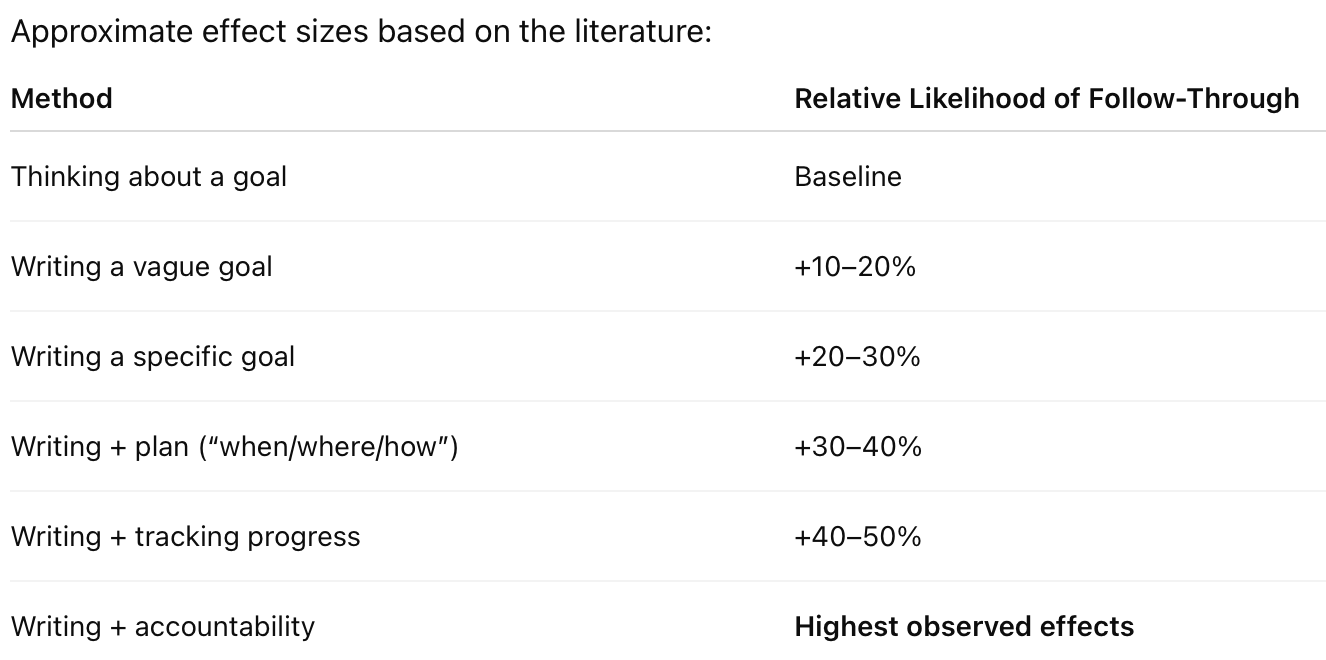
However, these can be fleeting, which is where writing the intention down can be extremely helpful. This method is often said to increase the chance of achievement by 42%. However, it depends on certain factors.
The Journaling Effect
In the front of my journal, I have the intentions written down for the year. Then, as my days progress along, I rewrite them into monthly and daily goals. For some of these, I track them, like going to jiu jitsu. I've usually written a vague intention, created a more specific goal, designed the plan, and then implemented the tracking. Finally, I also discussed them with my wife and one of my best friends.
Instead of asking your spouse, you could join a yoga or CrossFit group, befriend someone, and say "see you next time" as you leave. This marks the beginning of accountability and the culture shift needed to keep your personal change for the foreseeable future.
In-Summary
“Just do it” is not a command—it is an outcome. Action follows clarity, compassion, and commitment that have been revisited often enough to matter. When intentions are written, reflected on, spoken aloud, and lived in small daily choices, behavior begins to align naturally. This year, do not ask yourself whether you are motivated. Ask whether your intention is strong, visible, and supported. Close the gap not by pushing harder, but by steering more deliberately. The ship moves where attention goes.
Question: What is one Intention you'd like to write down today?
Listen to my full Clear Health Podcast on Intentions.

References
- Sheeran P, Webb TL. The intention–behavior gap. Soc Personal Psychol Compass. 2016;10(9):503-518. doi:10.1111/spc3.12265
-
Faries MD. Why we don’t “just do it”: Understanding the intention-behavior gap in lifestyle medicine. Am J Lifestyle Med. 2016;10(5):322-329. doi:10.1177/1559827616638017
-
Matthews G. The impact of commitment, accountability, and written goals on goal achievement. Presented at: Psychology Faculty Conference, Dominican University of California; 2007. Published in Psychology Faculty Conference Presentations. Dominican Scholar. Accessed via Dominican University digital repository.