Clear Health Newsletter (Read this on my Website) | 5-Minute Read
Alzheimers Disease (AD) affects over 6 million Americans and is projected to triple in number by 2060. AD is insidious and slowly cause functional decline in activities of daily living. For decades, scientists have known that tau — the misfolded protein behind Alzheimer's tangles — spreads from neuron to neuron like a contagion within the brain. What's been missing is the mechanism: how does tau actually hitch a ride between cells? A new study published in Cell (Tyagi et al., 2026) just answered that question, and it points to an unexpected accomplice: a gene called Arc, best known for its role in memory formation.
Three Things You Should Know
1. A "memory gene" doubles as tau's vehicle. Arc is known in neuroscience for helping consolidate memories at the synapse. Researchers found that Arc proteins assemble into virus-like capsules that package tau and ship it out of neurons in tiny extracellular vesicles (EVs). When Arc binds tau, it transmits it from neuron to neuron, packaged inside vesicles that protect the cargo as it travels. In mice genetically engineered to lack Arc, tau transmission between neurons was almost entirely shut down. In other words if you don't have an Uber, you aren't going anywhere.
2. Losing this "release valve" backfires for the original cell. It would be easy to assume blocking tau spread is automatically good — but the study found a twist. Mice lacking Arc actually accumulated more toxic tau inside their own neurons and showed increased signs of cell death early in disease progression. The implication: the brain may use Arc-mediated EV release as a way to clear toxic tau out of a struggling cell, even though that "exhaust system" doubles as the highway pathology uses to spread.
3. This shows up in real human Alzheimer's brains, not just mice. The team confirmed the same Arc-tau packaging in postmortem human brain tissue, and found that Arc levels in brain-derived vesicles correlated strongly with phosphorylated (pathological) tau levels in Alzheimer's patients — strongest in confirmed Alzheimer's cases. This raises an important clinical point: anti-tau antibody therapies, which have shown disappointing efficacy, may simply be unable to reach tau once it's sealed inside these vesicles.
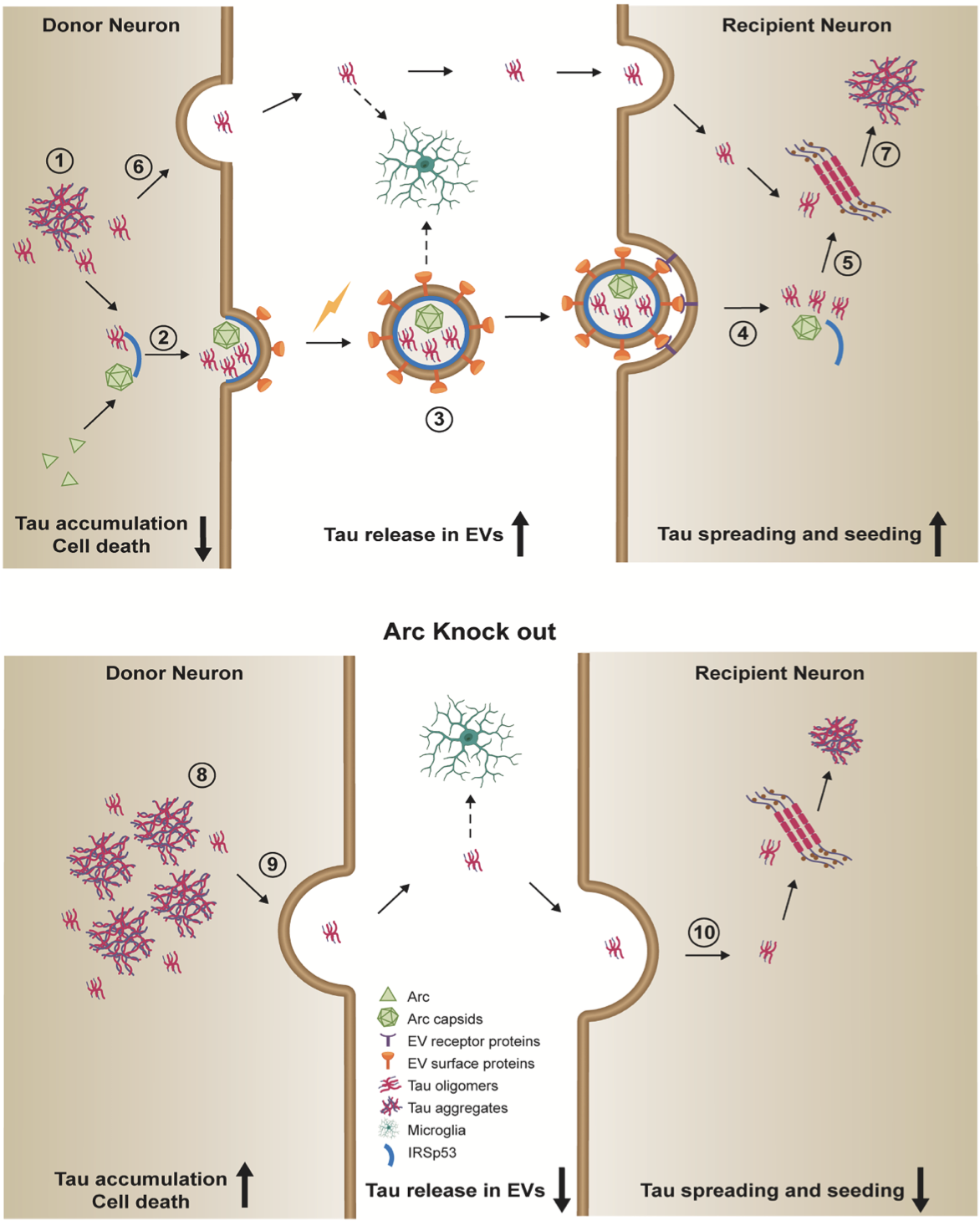
Image from: Tyagi, M., et al. (2026)
FDA-Approved Alzheimer's Treatments at a Glance
Disease-modifying (target amyloid biology):
- Lecanemab (Leqembi®) — anti-amyloid antibody, IV every 2 weeks (at-home injectable now available for maintenance); approved for early Alzheimer's with confirmed amyloid.
- Donanemab (Kisunla®) — anti-amyloid antibody, IV every 4 weeks; same early-stage indication.
While the above treatments work they do not specifically target the Arc pathway. Both slow — but don't reverse — cognitive decline, and both carry risk of ARIA (brain swelling/microbleeds) requiring monitoring.
Two Lifestyle Medicine Pillars That Matter Here
Sleep. A 2026 randomized crossover trial in Nature Communications directly tested this in humans: when participants slept normally versus were sleep-deprived, morning plasma levels of Alzheimer's biomarkers (amyloid-beta and tau) were measurably higher after normal sleep — evidence that the brain's glymphatic system actively flushes these proteins out overnight. Translation: prioritizing deep, uninterrupted sleep isn't just about feeling rested. It's a literal nightly detox cycle for the exact proteins implicated in this new Arc research.
Nutrition. From Schickedanz H et al. "The brain is the most metabolically active organ in the human body, and its function is sensitive to both acute and chronic vascular changes, as well as the constant flow of energy and nutrients. Nutrition plays a pivotal role in preserving cognitive function and delaying Alzheimer’s disease (AD) progression. For decades, we’ve known that the Western diet—typically high in calories, saturated fats, and refined carbohydrates—is associated with increased cognitive decline. Conversely, diets rich in fresh produce (and the nutrients and antioxidants they provide), and low in saturated fats and simple carbohydrates, are associated with lower ADRD risk."
For instance blueberries can improve cognitive performance and delay cognitive decline by 2.5 years. High intake of leafy grean vegetables has been shown to improve memory equivalent to being 11 years younger. Omega 3 and Vitamin B12 also play a pivotal role in neuron formation and transmission.
The Bottom Line
This is elegant, mechanistic science — not yet a therapy. But it reframes Alzheimer's spread as a packaging-and-delivery problem, which opens new drug-target possibilities (blocking Arc-EV release, for instance). In the meantime, the two levers patients can pull today — protecting deep sleep and whole food nutrition — target the same biological cleanup systems this paper implicates.
Listen to an Episode of the Clear Health Podcast on the Power of Nutrition

Sources:
- Tyagi, M., et al. (2026). Arc mediates intercellular tau transmission via extracellular vesicles. Cell, 189, 1–18. https://doi.org/10.1016/j.cell.2026.06.008
- Dagum, P., et al. (2026). The glymphatic system clears amyloid beta and tau from brain to plasma in humans. Nature Communications, 17, 715. https://doi.org/10.1038/s41467-026-68374-8
- Zare, et al. (2026). Sleep-Dependent Clearance of Brain Metabolites via the Glymphatic System: Implications for Alzheimer's Pathophysiology. Brain and Behavior. https://onlinelibrary.wiley.com/doi/10.1002/brb3.71374
-
Schickedanz H, Safaeipour C, Sherzai D, Sherzai A. Effects of Lifestyle Medicine on Alzheimer’s Disease: Insights From Emerging Evidence and Multi-Domain Interventions. American Journal of Lifestyle Medicine. 2026;0(0). doi:10.1177/15598276261417271
Disclaimer: This article is for general informational purposes only and does not constitute the practice of medicine, nursing or other professional health care services, including the giving of medical advice, and no doctor/patient relationship is formed. The use of information on this article or materials linked from this article is at the user’s own risk. The content of this article is not intended to be a substitute for professional medical advice, diagnosis, or treatment. Users should not disregard, or delay in obtaining, medical advice for any medical condition they may have, and should seek the assistance of their health care professionals for any such conditions.